Explain Different Parts of the Sun
There are two major motions affecting the Earth. Scientists who study the Sun usually divide it up into three main regions.
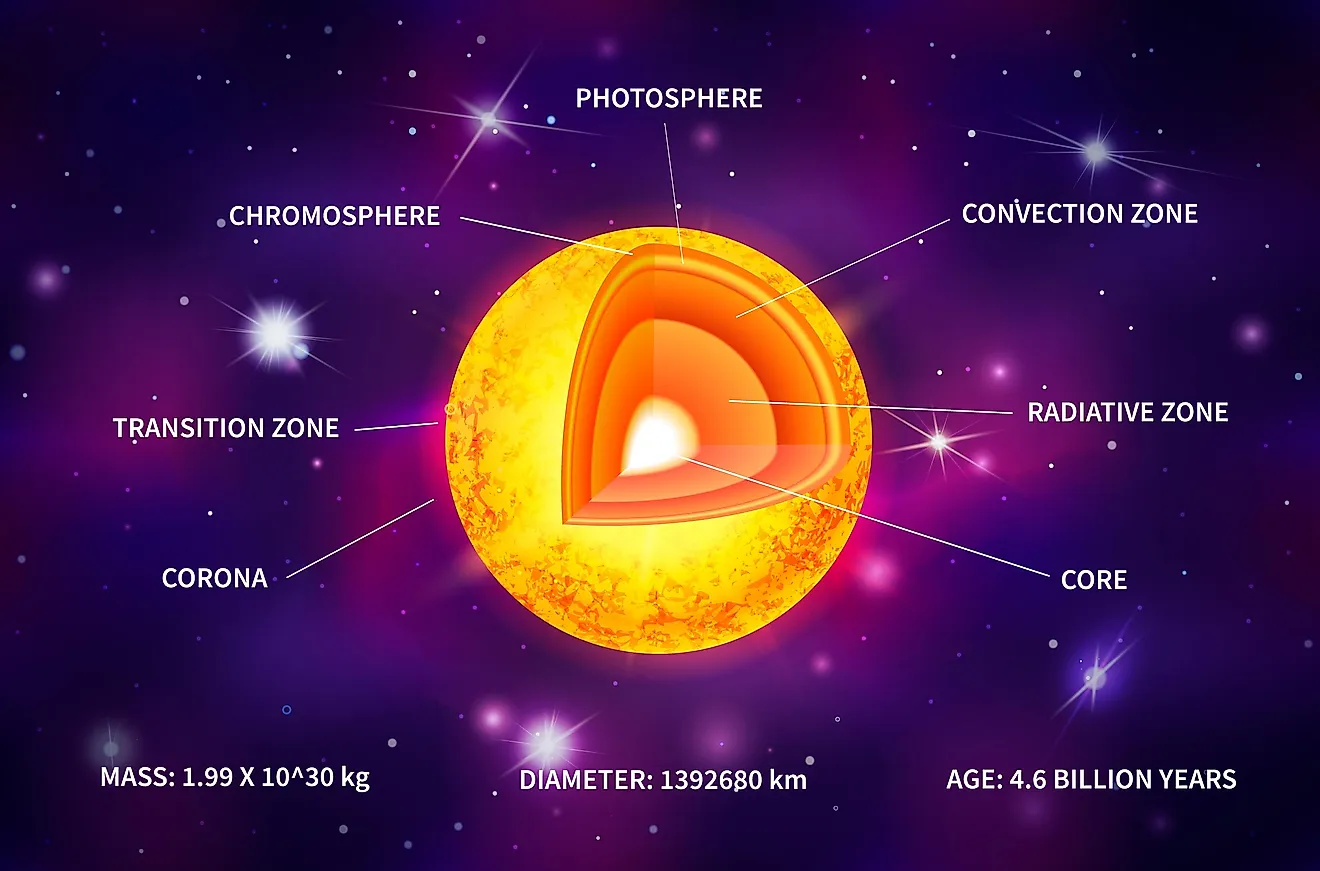
What Are The Layers Of The Sun Worldatlas
Suns Structure The sun is made up of six layers.
. This is the part of the piano that were all familiar with. For example HTTP Hypertext Transfer Protocol part of the URL represents that the page displayed in HTML format. The photosphere chromosphere and corona.
The core is at the center. Answer 1 of 6. Photosphere 6000 K The photosphere is the surface of the Sun.
Core radiative zone convective zone photosphere chromosphere and corona. This moves them from the inner parts of the Sun to the outer part of the sun that we see. All heavier elements called metals in astronomy account for less than 2 of the mass with oxygen roughly 1 of the Suns mass carbon 03 neon 02 and iron 02.
FTP File Transfer Protocol which is used to transfer files local to server. Visible IR and UV radiation The light that we see coming from the Sun is visible but if you close your eyes and just. It the hottest region where the nuclear fusion reactions that power the Sun occur.
The parts of the Sun that we can observe and measure directly are contained in the Suns atmosphere. In this layer the gases move like boiling water. The Sun doesnt actually have a solid surface because its a ball of plasma.
The corona starts around 10000 km above the solar photosphere. Moving outward next comes the radiative or radiation zone. Its rotation around its axis and its rotation around the Sun which we call revolution.
The highest part of. Shadows are areas where an object obstructs a light source so that darkness takes on the form of the object. Protocols are used to decide how files are displayed or transferred across the web.
However the corona can be viewed during a total solar eclipse. There are three main parts to the Suns interior. This is the region where light from the interior finally.
Above the photosphere is a layer of the atmosphere about 2000 km thick called the chromosphere. The northern hemisphere experiences summer during the months of June July and August because it is tilted toward the sun and receives the most direct sunlight. Higher-end piano soundboards are typically made from a type of wood like Sitka spruce.
The sun rotates at different speeds because of a concept called Differential Rotation which basically means that a rotating object is moving with different angular velocities at different latitudes or depths. The sun is a ball of gaseous plasmanot a solid bodyso the gaseous atmospheres of jupiter and saturnthe exterior of the sun rotates at different speeds depending onits solar latitudeThe polar ares of the sun rotate about once every 344 earth daysThe equatorial regions travel the fastestcompleting in just 2505 days. Parts of the Suns Atmosphere Photosphere.
The core the radiative zone and the convective zone. That means the reason we see different phases of the Moon here on Earth is that we only see the parts of the Moon that are being lit up by the Sun. This is the part of the sun we see.
Temperatures in the core exceed 157 million kelvin also 157 million degrees Celsius or 28 million degrees. The Suns interior the solar atmosphere and the visible surface of the Sun which lies between the interior and the atmosphere. The Sun doesnt actually have a solid surface because its a ball of plasma.
The amount of sun a region receives depends on the tilt of the earths axis and not its distance from the sun. The heat and light move from the core into this layer. Both are good options but have different qualities.
Cheaper versions use plywood. The phases occur because the Sun lights different parts of the Moon as the Moon revolves around the Earth. The material that reaches the top of the convection zone cools by giving of light.
The protocol is the first part of the URL and also called schema. The keyboard is a collective name for the white and black keys. Similar to the polar sun-path diagrams somebody takes pictures of the sky and starts collecting the data regarding the position of the sun quantized by the azimuthal and altitude of the sun.
Learn more about other parts of the Sun from the NASAs Solar System Exploration Division. Core The suns core more than a thousand times the size of Earth and more than 10 times denser than lead is a huge furnace. These regions have substantially different properties from each other with regions of gradual transition between them.
There are three main parts to the Suns interior. According to Nebular Theory the Sun and all the planets of our Solar System began as a giant cloud of molecular gas and dustThen about 457 billion years ago something. The corona is usually hidden by the bright light of the Suns surface.
What are the 7 parts of the sun. While the rotation of the Earth on its axis causes the nightly movement of the stars across the sky the revolution is responsible for the fact that we can see different parts of the sky at different parts. Now the azimuthal values are plotted along the X-axis and the altitude values are plotted along the Y-axis for different parts of the day and.
This region of the Sun. The Suns corona is the outermost part of the Suns atmosphere. Inversely summer for the southern hemisphere takes place during the months of December January.
The part of the Sun we see from Earth the part we call the surface is the photosphere. Different places experience sunset and sunrise at different times and the amount of time a location is in daylight and darkness also differs by location. This is where all the suns heat and light is made.
The Birth of the Sun. Photosphere 6000 K The photosphere is the. The Sun is composed primarily of the chemical elements hydrogen and heliumAt this time in the Suns life they account for 749 and 238 of the mass of the Sun in the photosphere respectively.
The core the radiative zone and the convective zone. On Earth a shadow can be cast by the Sun Moon or rarely Mercury or Venus. That makes it difficult to see without using special instruments.
Image 1 - Differential Rotation in the Sun Differential Rotation oc.

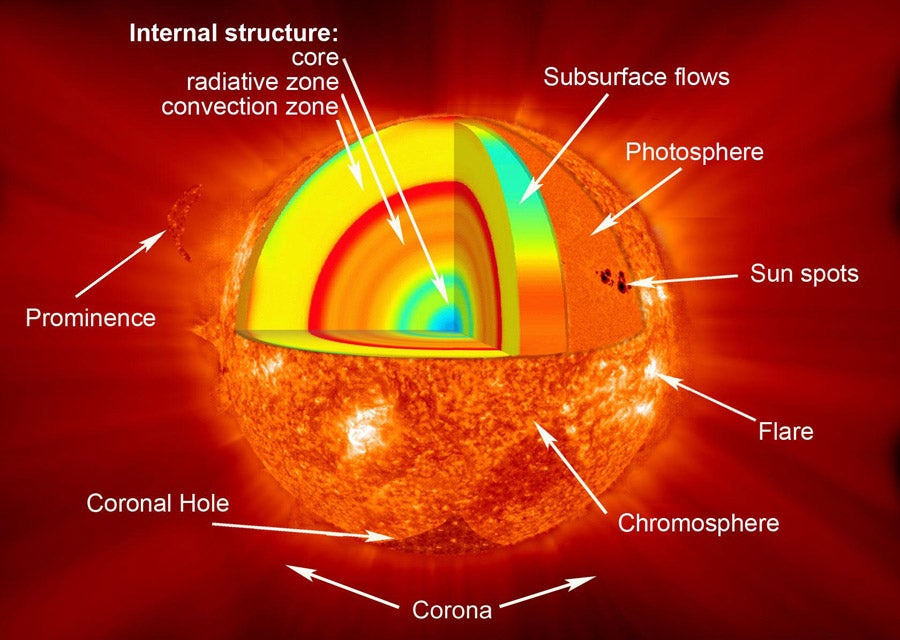
Layers Of The Sun Nasa

What Are The Parts Of The Sun Universe Today
Parts Of The Sun Center For Science Education


Comments
Post a Comment